Showing posts with label historical beadwork. Show all posts

Thursday, February 13, 2014

"Just Do It!" - Proof It Works

Last night, too excited to sleep, I tossed and turned for hours, my mind racing around the most amazing "just do it" story I've ever encountered.

Here's a little peek.


But first, if you read my blog or my books, you are well aware of my favorite motto: "Just do it!" I say it all the time when I teach and believe from many examples, including my own shy journey into art, book writing, and teaching, that it works like a charm. You can do anything, if you just do it.

Are you ready for this? Be sure to click on the picture so you can see the details!


This amazing basket, inspired by a similar 17th Century basket, was made by Rachael Kinnison, a woman who did not know how to bead. Take a closer look at some of the details...


Rachael says:   I have collected antique beads since I was in early grade school. I was always drawn to them, but never made anything with them.  The second I read about the beaded baskets ..., I knew why I had collected them for so long.  I saw the Corning Museum basket, and that was it, my mind was made up in a nano second, I had to make that basket~ I had no idea how~so I just looked at the pictures and did it. 

She just did it. See? It works!  Just do it, everybody, make up your mind, and do it!

Rachael kept track of her materials, how much silk ribbon it took to wrap the spokes, how many beads she used, and how many hours she worked to complete this museum-quality piece. She wrote about it on her blog, showing many step-by-step photos of the process. If you want to know how she made her basket, go to her blog, Lady's Repository Museum & Diamond K Folk Art, and start scrolling back through recent posts. It's such a gift. Thank you, Rachael!

Rachael entered her basket in a contest sponsored by Dr. Tricia Wilson Nguyen, of Thistle Threads. Go to her blog (The Embroiderer's Story) to see pictures of the runner-up beaded baskets, all definitely worthy of a look-see, if you like beads and beading.

You are looking at pictures from both Rachael's and Dr. Nguyen's blogs, placed in this post with their permission. I am grateful to both of them for posting such excellent photographs. And congratulations to Rachael for this magnificent achievement!

Monday, March 23, 2009

Short Subjects

Feb BJP ~ French knots & Colonial knots

My beading/quilting friends Christy and Lunnette introduced me to Colonial knots, assuring me that they're more secure than French knots. Christy says they're also easier than French knots. Maybe... after you've made quite a few. I agree however that for a consistent look and secure feel, Colonial knots take the cake. So all the knots on my Feb BJP are of the Colonial variety.

embroidery detail on February Bead Journal Project piece by Robin Atkins
The difference? Here is how you make a French knot. The thread is wound around the needle. The more winds, the bigger the knot. Here is how you make a Colonial knot. The thread is passed in a figure-8 around the needle. The size is not variable.

Knots vs. seed beads... I guess one could argue that I could have achieved the same affect sewing a single bead in the same location as each knot. That would work too, although the look might be a bit less soft. I enjoyed the meditative time spent making all the background knots on my BJP piece.

Teaching

As many of you know, I'm not teaching much right now. The reason I always give is that my mother, who is 92 and lives in Minnesota (a day's flight from me), is not in the best of health. I don't want to promise someone I'll teach at their conference and risk the possibility of having to cancel at the last moment because Mom's health takes a turn for the worse.
Also there's a certain quality-of-life right now that I call being on hold. It's based on the certainty that before long I will not be a daughter any more and will not have any parents... I feel a little in limbo, uncertain and adrift, as though I've stopped living while waiting for the change, even though it isn't really imminent and surely I'll adjust once it happens.
So this year, the second in a row for scaling back on teaching, I have only one definite gig. And that is just around the corner.

I will be teaching at the Bead Bazaar sponsored by the Rocky Mountain Bead Society in Denver, Colorado. Advance registration is open now. I'll be teaching:
  • Woven Treasure Bracelet or Tassel on April 25
  • Techniques of Bead Embroidery on April 26
I'll also be giving a Powerpoint presentation at their meeting located here in Denver on April 23. If you're in the vicinity you may want to come! Here is my topic:
  • Visual Journaling with Beads, Fibers, Threads and Fabric
  • View over 200 beaded journal pieces by 42 artists participating in the 2007-08 Bead Journal Project!
  • Compelling and inspirational, this unique beadwork tells stories, reveals emotions and follows important events in the lives of the artists who create a visual journal each month during the year-long project.
  • In this presentation, you will see some of the best!

Colorado beaders are wonderful! I've taught there previously and been very impressed with the level of skill and artistry. Several BJP members live in Colorado, including:

There's also a possibility that I'll be teaching during the first week of October in Arizona. Stay tuned on that one!

Clues ~ Mystery Beadwork

Here is a post showing beautiful fragments of historical bead embroidery, weaving and smocking that I bought 15 or so years ago. The origins of this 100+ year old beading were unknown by the seller, except that he bought it from a peddler in Mexico City. In the post I asked for help in identifying the origins.

Help arrived! I'll post the complete findings in a later post. But, in summary, the work appears to be from Mexico, probably from the Nahua natives of the central Puebla area. My information comes from two main source books: La Chaquira en Mexico and Costumes of Mexico both of which are well illustrated, fascinating books. (By the way, la chaquira = beads!)

Just as a teaser, here is one of the pieces in my collection.

historical beadwork, bead embellished pleating or smocking
Here is a diagram from La Chaquira en Mexico showing the techinque for bead embellished pleating, as done by the Nahua natives.

bead embellished smocking diagram
And here is a picture from the same source showing a blouse made with this technique. Incidentally, I think this blouse is more recently made and with a slightly different technique than the fragments I have. Yet there certainly are similarities.

bead embellished pleating from central Mexico
Choices

Are you familiar with Robert Glenn, the painter who writes a free newsletter about the artistic process, painting and issues affecting artists? I love reading his thought-provoking articles that come to my email once a week and thought I'd share a few words from his latest ~ about choices we make as artists. He writes:
Today I spoke on the phone to several colleagues. We were talking about planning versus improvisation. While many fine artists plan everything in detail and then simply execute, others admit they don't know what they're doing from the get-go, but they start anyway and spend a lot of time fixing up. Both systems work... The nice thing about choices is that they can be changed... The wayside choices we make, however minor or major, determine our signature, our style and our level of personal satisfaction.
So, the ol' improv vs. plan question comes up in all aspects of art, I guess. What do you think of his point about our choices determining our style and level of personal satisfaction?

Monday, February 23, 2009

Historical Beadwork ~ Smocking, Embroidery, Weaving

two rabbits, historical beadwork, vintage bead embroidery, Robin Atkins collection
This post is about a mystery... one I've pondered for a long time. Below you will see some precious fragments from beaded clothing. Some of it may be more than 100 years old! The mystery concerns the origins. Maybe one of you knows the answer.... And if you don't, just enjoy seeing it!

I bought this collection at a flea market in Seattle in 1992 or so. The seller told me he had bought it from a sidewalk peddler in Mexico City. The peddler and he did not have a language in common, so he learned nothing about them.

In each set, the first picture, the one with the rule, will be approximately the actual size when you click to enlarge it. The other, detail pictures will be larger than actual size so that you can see exactly how this beautiful work is done. When you click to enlarge you can just about see every thread! I'll show them in sets and make a few comments about the techniques and materials for each set.

two rabbits, historical beadwork, vintage bead embroidery, Robin Atkins collection
rabbit, historical beadwork, vintage bead embroidery, detail, Robin Atkins collection
I believe these little rabbits may have been part of a sampler, or possibly a practice piece. The fabric is a fine, even-weave cotton or linen and appears to be homespun. The technique seems to be like counted-thread, slanted Gobelin needlepoint embroidery, worked on the diagonal across three threads of the fabric. There are 21 beads in a one-inch line or 441 beads per square inch. I think the beads are size 20 or 22. The size and colors of the beads suggest that this piece may be from the late 1800s or early 1900s.

historical beadwork, smocking, shirring, pleatwork, Robin Atkins collection
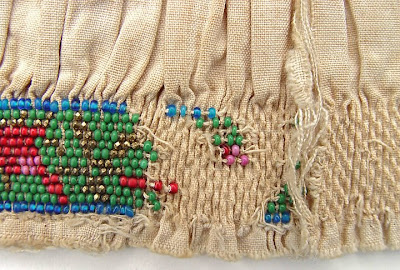
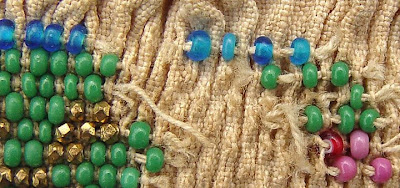
This piece may be the oldest of the lot. The fabric is dark from age and there is much damage to the threads and fabric, which appear to be cotton or linen. Here the technique is bead-embellished lines of running stitches which tightly pleat the fabric. There are about 40 pleats per linear inch. Up to 20 beads per inch are added every other pleat according to the pattern. The same thread gathers and adds beads. There are 15 rows (top to bottom) of gathering stitches per inch.

The beads used on this piece are slightly larger than the ones used on the rabbit piece. I'd say they are a mixture of 20s and 18s. It looks as though the stitches are counted with two threads per stitch. And the rows alternate whether the stitch is on front or the back. I think the technique may be some type of smocking, although I can't find it in the on-line guides to smocking stitches. The band at the top is back-stitched with thread, making a pattern visible on both sides of the piece.

The design seems European, perhaps Transylvanian in origin. There is a suggestion of folk art to the design.

historical beadwork, smocking, shirring, pleatwork, Victorian floral design, Robin Atkins collection
This piece amazes me. Like the one above, the fabric is smocked with rows of horizontal running stitches. One bead is added per stitch. There are 34 pleats per inch, 17 beads per linear inch, 18 rows per vertical inch or 306 beads per square inch. The design again seems European, typical of the late Victorian Era.

historical beadwork, smocking, shirring, pleatwork, Robin Atkins collection
This piece is the same smocking technique, with even smaller beads. Here there are 50 pleats and 25 beads per linear inch. The beads are so small they look like little grains of finely ground pepper. I think they're about size 22 or 24. There are 22 rows per inch, which makes 550 beads per square inch! The bottom is hand-hemmed. Might this have been the cuff on the sleeve of a blouse?

historical beadwork, smocking, shirring, pleatwork, Robin Atkins collection
This piece of beaded smocking has 16 beads per linear inch. The bird and berry design may be a bit more recent than the previous examples, but could still be European.
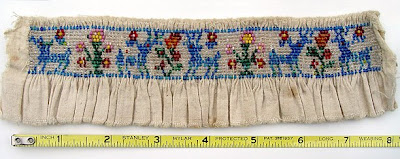
historical beadwork, smocking, shirring, pleatwork, deer and flowers design, Robin Atkins collection
This deer and flower design has the look of Latin America to me. The beads are a little larger than in the above example, with 15 per inch.

historical beadwork, smocking, shirring, pleatwork, llama and flower design, Robin Atkins collection
This piece seems much more recent to me. The fabric may be homespun cotton or possibly machine made. The hem is machine stitched, unlike all the other pieces which are totally hand stitched. The beads are probably size 13. There are 13 beads per linear inch. This llama (or alpaca design) seems to be Latin American.

vintage bead embroidery, dog design, Robin Atkins collection
vintage bead embroidery, leaf detail, Robin Atkins collection
vintage bead embroidery, border detail, Robin Atkins collection
This piece is a real mystery. What part of the garmet was it from? The technique, like the rabbit piece, seems to be counted-thread stitching. The beads are quite small, mostly size 18. I have no sense of the design origin, especially the coloring of the dog. The thread, like the home-spun fabric, is either cotton or linen. I love this design, so I've shown some of the details. Isn't the leaf great?!

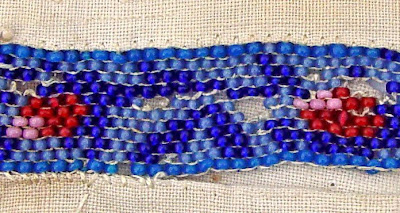
vintage off-loom bead weaving, Robin Atkins collection
vintage off-loom bead weaving, Robin Atkins Collection
This is one of two pieces in the collection that use a different technique. The strips of beadwork are done with an off-loom weaving technique. I'm not sure what the weaving method is... perhaps a type of brick stitch. The woven strip is used as a seam embellishment, with a piece of fabric whip-stitched to each edge of the strip. The beads are quite tiny... size 18 or 20.

vintage off-loom bead weaving, Robin Atkins Collection
This last piece in the collection is so tattered... It's done the same way as the one above with size 20 or 22 beads woven into strips and sewn along the edges to home-spun fabric. I'm intrigued by the design because each strip is a different pattern. What part of a garmet could this be from? It seems to have been sewn to an adjoining pleated or smocked piece.

That's it. Aren't these amazing? My theory is that they are all from some village in Mexico or South America (maybe Guatemala) where a group of Eastern (?) Europeans settled at the turn of the century. The women in this group embellished clothing with these three techniques using tiny glass seed beads they brought with them. They taught their children and the tradition was passed down for several generations. Initially the designs were familiar, floral designs of Europe. But over time, they began to use local motifs. What do you think about my theory? Or do you, perhaps, have more concrete knowlege about this work? If you know someone in the know, please call their attention to this post... This mystery needs to get solved!

Thanks for looking!

* * * * * * * * * *
Feb. 24, 2009

I've just learned what is probably the correct name for this type of smocking from Barbara Meger, who does a lot of smocking and is a member of EGA. She thinks this is a type of pleatwork called Italian shirring, which unlike other forms of smocking is not intended to stretch. Here's something I found on this website that may interest you.

"Shirred fabric is a form of fabric manipulation. Modernly it is a form of smocking called Italian smocking or Italian shirring. Shirring runs the gathering threads in a way that creates designs in the pleats as they are gathered. An alb, credited to be that of St. Bernulf, dating from the 11th century is possibly the earliest form of this technique. A second alb that of Thomas Beckett’s from the 12th century also has this form of shirring in the pleated gores. It does not seem to be a common technique during the next 400 years. It is not noticeably seen in portraiture, nor does it show up in the few extant garments until the end of the 16th century/ early 17th century . One example dating 1600-1650 is on a men’s Italian shirt, currently in the collection of the Los Angeles County Museum of Art."

* * * * * * * * * *
Feb. 24, 2009

The Lone Beader wrote a comment to this post suggesting that I donate this historical beadwork (I love that term for it!) to a deserving museum. That's exactly what I intend to do! I'm considering the The Textile Museum in Washington DC.

* * * * * * * * * *
April 2, 2009

From a couple of books and this site, I have learned that these fragments very likely originated in the Cholula-Atlixco-Puebla Valley region of Mexico and were constructed by Nahua natives. Check this picture...

Mexican blouse from Pueblo region, Field Museum collection
Notice the side panel and it's similarity to the panel pictured above with the pink dog? The mystery seems to be solved at last!