The most common question
I'm asked when teaching is,
"What goes with this?"
or
"Which of these beads goes better
with this fabric?"
Don't we all want to know what goes with what? Yep, I think we do. So sit back and play with some fabrics with me. Be prepared, it's a long post (with a lot of pictures), hopefully worth your time!

This is a God's Eye quilt made by Kitty Sorgen. Using many little scraps and left over strips of fabric, it carries wonderful memories and invites a warm cuddle. Kitty says the idea comes from the Huichol people of Mexico, who wind yarn around crossed sticks making ornaments which they believe will protect their children. (
Here's great a blog post about making beaded, yarn God's Eye ornaments.) Below is a detail of a few of the blocks in Kitty's quilt.

What I love most about Kitty's quilts is the way she puts a little of this with a little of that in such a pleasing way. So, when she offered to teach her God's Eye quilt to our Guild, I instantly registered for the class, not because the technique is difficult (it isn't), but because I wanted to learn everything I could from Kitty about
what goes with what! Some of what follows are lessons I learned from Kitty; some are principles I've known for a long time; some are ideas which came to me while making 100 blocks (enough for two large lap quilts) in the past three weeks.
Let's look at a few of these blocks...


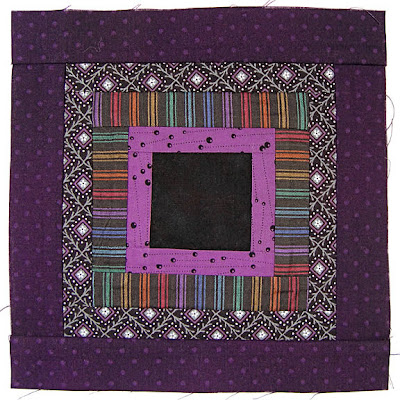


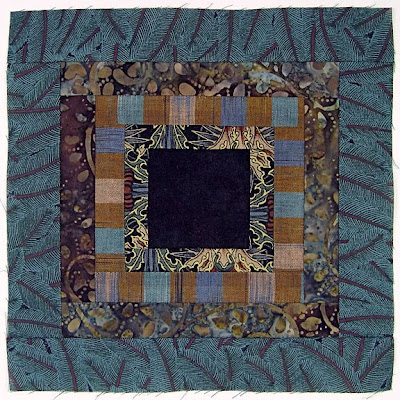
Do you see how each block is a little mini-quilt all by itself? We can look at each one and ask two fundamental questions of design: "What gives it unity and what gives it interest?"
Unity. How do we achieve unity and/or harmony when putting different fabrics together? The surest way is to keep certain things constant. For example:
-type of fabric (ie. all batiks, all quilting cottons, etc.)
-color (ie. single or
analogous color schemes)
-scale of patterns printed on fabrics
-subject or theme of patterns printed on fabrics
-value (lightness/darkness as measured on a greyscale)
-one consistent element (ie. black center in each block)
Variety. How do we achieve interest, variety or sparkle when putting different fabrics together? It's easy because there are so many different types, colors, patterns and styles of fabric. One could even put a block together that's basically all the same color, yet achieve interest by changing the scale of the prints. Below is a mostly red block, the varioius scales providing ample variety to make it interesting.
 Balance.
 The important point when combining fabrics is this: There must be a pleasing balance between variety and unity. Too much unity and the work will be boring. Too much variety and it will seem chaotic and unsettling.
To play with and learn more about this concept, look at a few of your older works of art, ones you haven't looked at for a while (quilts, jewelry, bead journal projects... whatever). Ask yourself, "What gives this variety? What gives it unity? Am I bored looking at it? Does it make me feel uneasy? Is there a pleasing balance between unity and variety?" Honest answers help us fine-tune our sense of balance for future projects.
Back to God's Eye quilt blocks, the most fun aspect of balance is considering the personality of the fabrics. Think about it! Some fabrics are gentle and sweet, some are bold, some ultra-modern, some very old-fashioned, some sing along harmoniously, some are a bit off-key.
We could conceivably put very different colors and scales of prints together and still have balance if all the fabrics have similar personalities. Below is a good example.

All four fabrics are "forest girls," reminding us of things natural and organic... earth, water and plants. Although one fabric is a batik, one a woven stripe, one a plain tone-on-tone and one a quilting print, together they tell a nice little story, united by their common personality traits.
For me, the personality factor overrides all other considerations to the point where I use it almost exclusively in answering the question, "What goes with what?"
For my God's Eye blocks, I think of each fabric as a girl living in a college dormitory. Most importantly, she must get along with the other girls in her room, while also sharing slight commonality with all the other girls in the dorm. If the girls in one room are too much the same, they won't learn and grow from or be stimulated by each other. If they have nothing in common, they'll have problems getting along together.
Below, for example, are the beginnings of 7 blocks. I've selected one girl for each room and a roommate to go with her. I've sewn two sides and am beginning to see how well they get along together (click to enlarge if you like).

Here they are again, now with three sides sewn and a clearer idea of their developing friendships.

I like to think about their field of study. For example, at the top left, we have a philosophy major and a math major, both interested in solving problems. Just below (second from left in the second row) we have a boisterous theatre major rooming with a shy gal who studies geology. As opposites, they might be good influences on one another, but they may need a bridge, someone with interests in both their fields, to join them.
When all four sides are sewn, it's time to audition fabric strips for the third roommate! I pre-cut strips from my stash, using scrap fabrics from my bead journal project pieces from the past three years, most of the quilts I've made, several dance costumes made long ago and fabrics I've bought for spirit dolls, heart pins and other beading projects over the years. Here's a stack of strips.

And here's how they look spread out on the table ready to be auditioned.

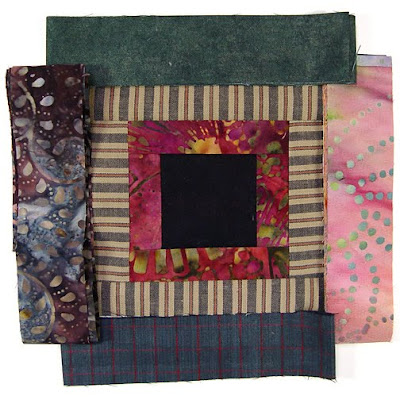
Above you can see the first two of our gals have narrowed the field to four possibilities for their new roommate. They like the calming influence of Ms Earth Sciences (green) and Ms Horticulture (brown batik). Ms Math major has interests in common with Ms. Computer Programing (grey with red grid), but is concerned that she'll study into the wee hours of the night. Both think Ms. Art is fun, but worry that she might be too messy in the long run. Which do they choose?

As you can see above, they chose Ms Horticulture! And now the three of them are auditioning for their fourth and final roommate. Clockwise, from the top, we have Ms Botany, Ms. Environmental Studies, Ms. Entomology and Ms. Asian Studies. Right away, they realize they don't have enough in common with either the right or left possibilities and the choice is narrowed. Although either the top or bottom choice would probably be satisfactory, they pick Ms. Entomology because she has lots of energy, yet is fairly quiet. Below you can see how they look together.

Kitty likes to talk about the group as a choir, asking if there is a soloist, a duet or if we have a chorus of many voices singing in harmony. Take a look at this next set of auditions and see what choir situation comes to mind.


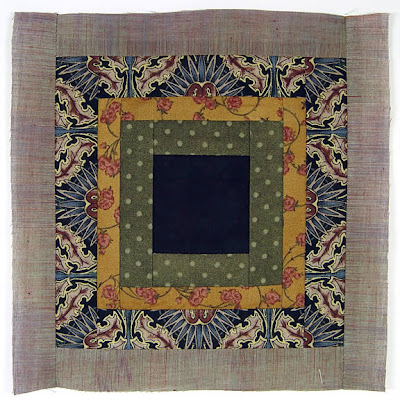
Another way to look at personalities is to think about conversations at a dinner table. One person (the first strips around the black center) talks to the second ring of strips; then a third ring joins them. How does the conversation change? Is one dominating the conversation? Is the conversation interesting? What do they need from the new (fourth ring) participant, a calming influence perhaps, a little sparkle of humor, a brighter point of view? Let's look at another set of auditions below with personality choices based on imagined conversations between the fabrics.

What conversations are happening above? What does each fabric choice contribute to the already flowing conversation between the first two fabrics? I chose the wide stripes because a little orderly reasoning seemed to compliment the more light-hearted chatting between the first two fabrics and the multi-colors complimented the floral fabric.
Below are the audition strips for the next fabric followed by the four possibilities I thought might join well in the conversation.


What happens with each of the four possibilities for the final conversationalist in the group? How does the conversation change depending on which is selected? Below you can see which one I thought would fit best into the already lively conversation. She's a good listener, don't you think?

Just for fun, I'll show you a couple of other auditions. You can look at them as conversations, roommates, a choir or in any way that identifies the personality of each fabric. Try to pick the one you think will work best and then scroll down to see if your choice matches mine.


And, two more....


Sometimes the auditioning goes very easily, intuition providing an instant decision, a choice that instinctively feels right. At other times, the process is very sticky, nothing seeming to fit. Below is a choice like that.

The first row of strips is very dark, a Hungarian resist-dyed fabric with a dark indigo background and simple paisley design. The second row is high contrast, a light blue-grey batik. That they are both hand-dyed and both have dot patterns binds them together. What do each of the four possible new fabrics, above, have in common with these two?

Narrowing it down the two above, I still couldn't decide. So I spread each of them around two sides of the block to get a better idea. The pink polka dot fabric seems cheerful and echoes the pink dots of the paisley in the first fabric. The ducks are more subdued yet add a nice sense of flow that compliments both the paisley and the colors of the second batik.

Sometimes I need to squint at my fabrics to see how the lightness and darkness (value) of them plays out. Removing all color from the picture, you can see that the pink fabric isn't as high a value as you might think from its bright personality, reading as a medium-value fabric.
Deciding the pink was too much sparkle, too dominating, I eliminated it from the running and re-auditioned the fabric printed to look like ikat along with the still-in-the-running duck fabric.

And just for kicks, here's how they look through squinty eyes.

Which would you choose? Probably either would look fine. However, I decided the ducks provided a necessary link between dark and light, while also adding flow. Below you can see how it looks along with the four possibilities for the final set of strips.

This choice wasn't quite so difficult. Although I think the purple-rose fabric with little rings of dots has circles in common with the first two fabrics, it seems too sweet, two romantic to be comfortable with them. The teal plaid would have been OK, except it seems too sombre with the other two dark fabrics. The light purple talks with the color of the duck's breast, but again seems too sweet, too much of an air-head. Stars, light and fun, lifting the spirits of the dark girls, has to be the one! Here's how it looks, finished...

* * * * *
OK, enough about blocks! Now that the roommates are all chosen, we're heading toward the more challenging decisions involving the whole dormitory. Which groups of roommates will be good neighbors?
I'm working on it! Below is a first run assignment sheet for one of my quilts. I plan to look at it pinned on my design wall for several days, checking for rearrangement possibilities.

As with individual blocks, it helps to squint at it (and/or look at it through a magnifying glass) to see where the lightest and darkest values are and if they are balanced. Below is the same picture in black and white. Do you think it's balanced yet?

And below is a possible arrangement of the second group of blocks. Again, it's an on-going process, one that requires a little time and patience.

* * * * * *
Sewing these blocks makes me totally happy... I LOVE it! I love cutting the strips and using fabrics and scraps I've had for many years, even decades. I love seeing how, with the addition of each side, the band of fabric around the center closes and joins in the statement of the block. I love auditioning!!!! And I'm loving the process of deciding how the blocks will fit together.
Guess what? I still have more cut strips, enough for one, possibly two, more of these quilts! Since I'm not at all bored with making the blocks, I see another 100 more of them in the near future.
Beads? Yes! I still bead. Working on these blocks has so inspired and invigorated me that I'm back to beading! I'm almost finished with my January Bead Journal Project piece and will post it soon... and you'll see something about it that won't surprise you at all!






 Posts
Posts


