What “world beads” do you have in your stash? You may have more than you think! Here are a few of mine…
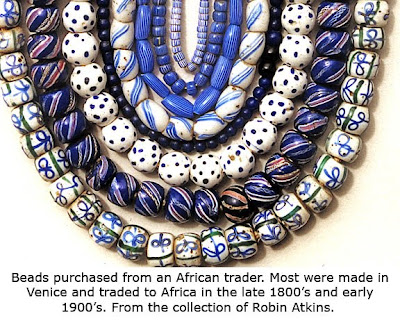
We buy beads in a local bead shop or in the comfort of our own home computer. But where were they made? Where have they traveled before we found them?

The origins of beads, particularly those in my stash, has fascinated me since day-one of my beady career 24 years ago. Joining my local Bead Society, where most members had a collector’s perspective about beads, and attending early Bead Conferences, which were more about the history of beads than making things with them, I began to appreciate that beads are truly ubiquitous!

Did you know that beads are one of man’s earliest artifacts? It’s possible that beads predate vessels and primitive tools in many cultures. Did you know that men and women of nearly every society, every culture and every land since the beginning of mankind have made and used beads in one or more ways?

Beads, being small, portable, long-lasting and made from various, naturally-occurring substances, have been a trade commodity for many centuries. Thus they have traveled the world in the hands of traders and merchants, sometimes for centuries. They arrive in our stash, some new and some used, from far-away places around the world.

Just as groups like the
Bead Journal Project and other internet-based beading groups unite people of the world, so do the beads themselves. More than anything else about beads, their ubiquitous nature fascinates me!

So too, the world-connection of beads intrigues Ray Hemachandra, editor of a book, recently published by
Lark Books -
Beading with World Beads, Beautiful Jewelry - Simple Techniques. This book features 30 jewelry projects with an international and multicultural flair created by 15 acclaimed jewelry designers.
Lark asked me to review several of their books and offered a signed copy of each one as a blog giveaway. And so, this is the first of my reviews. Someone who makes a comment on this post will win an autographed copy!

Those of you who know me, are aware that I’m not really a recipe type of gal with my art (or my cooking for that matter). For me, it is simply more fun to “do my own thing” than to replicate a design by somebody else. Consequently, I don’t gravitate toward “project books,” preferring technique or inspirational guides.
Happily,
Beading with World Beads, gives so much more than projects! First, there’s the whole idea of beading as “a multicultural bonanza – a melting pot of craft practices that yields innovative combinations of materials and influences,” to quote editor, Hemachandra. I love this concept and how it is realized in the unique creations of the designers chosen for the book. All of the jewelry is appealing and mysterious because of the cultural roots found in the materials and designs.

The second thing I really like about this book is that all the projects are based on sound design principles. They are well-balanced (although not necessarily symmetrical) and the different beads used in each piece have relationship of scale, color, style and origin. So even if I choose not to replicate any of the projects, each is an inspiration to me and offers challenging ideas I can apply to my personal world bead stash in my own way.

Looking at the photos in
Beading with World Beads makes me crave making jewelry again, makes me get out my African trade beads and view them as potential designs rather than a collection, makes me remember things in my stash long neglected! And by the way, the photos are outstanding, something I always admire about books published by Lark.
Lastly, I have to bravo the book for its clear, concise step-by-step instructions for each of the projects. For each project, excellent editing results in consistency and clarity that are rare in project books.
In conclusion, I give
Beading with World Beads an enthusiastic two-thumbs-up!
Would you like to win an autographed copy on this blog giveaway? Yes? Then make a comment in the next 10 days. Just for fun, tell me about something you love in your world bead stash! To be eligible to win, you must give me a clear way to get in touch with you - phone, email or snail mail address. (BTW, it's safest to give your email this way:
name[at]provider[dot]com. Use the [ ] signs and substitute the word
at for @ and
dot for .)








 Posts
Posts


