Monday, March 05, 2012

Writing & Publishing Beading Books, Part 4


Preparing a Book for Traditional Publishing

If you’ve been reading Parts 1-3, you know that my first book was self-published. Book #2 was published by Interweave Press, with some dissatisfaction on both sides, leading me to stick with self-publishing for books #3-7, the last of which was released in 2008.

Bead Embroidery - Beading on Stiffened Felt
After that, my focus shifted from books to family, as my parents’ health declined. First I lost my dad, and last March, my mom. Those were some tough years. I didn’t have extra energy to produce books. Yes, there were a couple on the back burner (still there), but nothing happened. In fact, I thought about retiring, not from doing beadwork, but from teaching and authoring beading books.

Three months into the grieving process for Mom, a brief message arrived via email. I almost chucked it out. It said, “I am an acquisition editor for Creative Publishing international. Looking for an author for The Complete Photo Guide to Beadwork. Please contact me if you might be interested."

“Yeah right,” I thought, “sounds like one of those typical, run-of-the-mill, blah-formula project books that totally don’t interest me.” To this day, I’m not sure why I replied, cautiously asking for more information.

Bead Weaving - Sculptural Peyote
Good thing I did, because it has given me the opportunity of a lifetime! Turns out CPI is the American branch of Quayside Publishing in London. Once I started researching their line of Complete Photo Guide books (to Jewelry Making, Textile Art, Knitting, Creative Painting, and more), I am totally impressed. All of them emphasize techniques and feature lots of stunning photography. Plus, they are comprehensive, large-format, 250+ pages, and beautifully printed on high-quality paper. To be part of this series would put me in very good company! If you’re not familiar with this series of books, take a look on Amazon, or better yet, check out your local Michael’s, which carries many of them in their book department.

Bead Stringing - Hand Knotting
After seeing the books, I knew THIS would be a chance to write the book I’ve wanted to own ever since I began beading in 1985, a book that could teach me all types of beading, give me information about beads and in-depth methods for designing and finishing my bead projects. It would need to include the following main sections:

About Beads - Trade Beads
1. All about beads ~ giving important tips and information that would help me choose beads for my projects, for example, how to tell the difference between stone, glass and plastic beads, or the difference between fake and real pearls.
2. Bead stringing ~ with “teaching-projects” designed to build skills from one to the next, including Japanese pearl hand-knotting methods and beginning-to-advanced wire working.
3. Bead weaving ~ again with progressive skill-building projects, including chapters on peyote, brick, right angle weave, netting, crochet and knitting with beads.
4. Bead embroidery ~ starting with making a stitch sampler of all the basic, fancy, edge and fringe stitches, and progressing to projects that emphasize various design approaches and base materials, including fabric, stiffened felt, fiber-collage and paper.

Bead Embroidery - Beads & Fiber Arts
Wouldn’t that just be the cat’s meow? My students and customers have been asking for such a book FOREVER. I don’t know why it’s not been done before. But I can assure you, it’s being done now!

I’m getting ahead of myself. So, with excitement and a lot of trepidation about whether I could pull it off successfully, I signed another book-length contract and got to work. A word about contracts. They’re written with the publisher’s best interests at heart, of course, and prevent them from liability. Plus this one essentially gave the publisher the right to re-publish “my book” or any part of it in any country, in any language, in any form without compensation to me. It’s also an unusual contract in that they pay me a flat fee for preparing the book. There are no royalties. I guess this would be good for me if the book were a flop. But I honestly expect sales will exceed their wildest dreams.

Bead Weaving - Netting
For about 2 minutes, I wondered at my sanity. I knew it would require untold hours of work and energy, probably amounting to a wage of about $1 or $2 per hour. But I didn’t care. I wanted to write this book. I wanted to give back to the beading community some of what it has given me in the past 28 years. I wanted to do it for the love of beads and beading. So I signed.

Different publishers work differently with authors. CPi seems very trusting, allowing me to build the book the way I think best, as long as I stay within the general style of the series. They also gave me permission to recruit guest artists to contribute teaching projects in areas where I lack expertise.

Bead Embroidery - Improvisational Design

My first step was to produce a rough outline of the topics and projects that needed to be included. Then, taking a hard look at my own beading skills, I noted those areas where I was lacking and set about finding guest artists. Fortunately I have a great network through the Bead Journal Project, teaching, and blogging. I soon found 9 artists who were willing to help me. They would design a project, write the instructions, take step-out photographs and send everything to me. I would make their project, following their steps, and then edit everything to be consistent in style with my own instructions.

I am much indebted to these wonderful, talented artists! Their contributions round out the book, making it truly comprehensive in a way I couldn’t have done on my own!

Bead Stringing - Complex Wire Working
The deal with CPi is this: their professional photographers take the beauty shots, exquisite pictures of the finished projects and variations. I’m responsible for the step-out pictures. Since I took all the photographs for my previously self-published books, I figured this would be manageable. Well, it was, but not without countless hours of working on the images in Photoshop and frequent re-shoots. It was the most difficult challenge of all to get images that would be up to the high standards set by this series of books.

I had three submission deadlines: Sept. 1, Nov. 30, and Feb. 27, with approximately 1/3 of the text, images and beaded objects due each time. Somehow, thanks to my husband, guest artists, the universe, and internal strength; I met each of the deadlines.

Bead Embroidery - Sampler of Stitches
The art log… Oh boy, that was another challenge. I gave every one of the 597 images and 80 beaded objects sent to CPi a unique number, recording it in the art log (an Excel document). Then I inserted these numbers into the manuscript, indicating placement of each picture within the text. In the end, the printed proof-sheet with each numbered image, the numbered objects, the art log and the manuscripts all have to match… exactly… no missing images, no images without a corresponding placement in the text. Yikes. Let me say, even for a fairly well-organized person, keeping track of everything was another huge challenge.

The final challenge was budget. Apparently the world economic situation is affecting book publishing too. In January, the editor informed me of cuts. Some titles were cut entirely. Thank goodness, mine was only cut in length. Although a few non-essentials had to go, the book remains true to my original concept and fully comprehensive.

Bead Weaving - Knitting with Beads
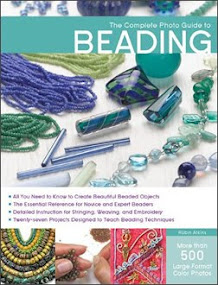
It’s complete! After 8 months of non-stop work, the final submission went to CPi by FedEx on time. Now it’s in their hands. Their book designers, editors, and photographers will build the layout of the book, edit my manuscript, design the cover, and make it all come true. According to the editor, I will have an opportunity to go over it again before they go to press. Then it will be printed, somewhere in Asia, bound and released late this year. My baby, my dream, my gift of bead love, will be on the shelves at last! Look for the this title: The Complete Photo Guide to Beading by Robin Atkins!

The pictures in this post are little sneak-peeks, parts of photos that will be in the book. I'll show you more later when the layout process is complete.

Bead Embroidery - Quilting with Beads
Are you wondering how it happened that the acquisition editor contacted me in the first place? I did, and so I asked her. She said she searched the internet for bead artists. One of the first things that came up was this blog, Beadlust. She scanned through it, noted my writing skills, noted that I take decent pictures, and noted on the side bar that I’ve written bead books previously. Then she went on to look at other search results, but said she kept thinking about what she’d seen on Beadlust and my website. In the end, I was at the top of her list. And since I said yes, the rest is history.

In this case, as in co-authoring with Amy Clarke (see Part 2, here), I got lucky. I didn’t seek a publisher; they came to me. Luck means being in the right place at the right time; it also means being true to your passion and being public with it in every way possible… teaching, networking, and the internet.

In the final installment (Part 5) of this series, I’ll list a few tips and conclusions about writing and publishing books. If you’ve considered writing a book, I hope these words will help you to give it a try!

Sunday, March 04, 2012

Writing & Publishing Books - Part 3

Return to Self-Publishing

Five more self-published books followed my experience with Interweave Press (Beaded Embellishment, see Part 2, here), with varying degrees of success.

The first of these, the only non-beading book of the 8 books I’ve written so far, was a lesson learned the hard way. Feeling cocky with the continuing success of One Bead at a Time, now in its third professional printing, and sure that traditional publishing was not for me, I collaborated with my husband on a picture book about the Washington State Ferries in the San Juan Islands. I wrote and designed the text; he took the pictures. We were certain every resident of the islands would buy several copies, one for themselves and (we hoped) some for gifts. So we scraped together all the cash we could and went big, ordering 3,000 copies.


Immediately on receipt of our payload, we noticed an alarming problem. The covers of the books, mostly black ink, as you can see, grabbed fingerprints in a way that would make a forensic scientist ecstatic. Grim!

That, right there, is one big problem of self-publishing. The printer you hire does exactly what you tell them to do. If you don’t tell them to print a coat of varnish on the covers before assembling and binding the books, they won’t. And if you don’t KNOW to tell them to varnish the covers? Well, then you get ugly fingerprints. Imagine the book on the shelf in a book store. Two customers pick it up to take a look. If neither of them buys it, the thing looks shop-worn, totally unattractive already.

Not knowing what else to do about it, we bought cans of Krylon matte spray fixative (used, for example on pastels and pencil drawings), and painstakingly sprayed each cover. Although it looks better than fingerprints, it made the covers a bit dull and some got tiny bubbles, pock marks. Some were ruined because we touched them too soon.  I guess the alternative would have been to get the covers reprinted and the book re-bound, but we’d already spent all our available cash getting the books printed.

That wasn’t the only card stacked against us with this book. The ferries had just undergone a big change, increasing their fares dramatically and cutting back the service and number of runs. Maintenance budgets were also cut, resulting in rust and dirt accumulation. Our lovely ferry service was a thing of the past, and people were grumpy about it. We had counted on a favorable attitude, reverence and nostalgia, to sell our book. Instead, we found that grumpy people weren’t very interested. We have yet to sell enough copies of the book to pay ourselves back for even half our printing expenses, and of course have earned nothing for our time.

What did we learn?
1. Print a test run; or at least keep the first printing to a minimum.
2. Hire a printing consultant to advise on things like the need for varnish on the covers.
3. Maybe for such a book, in this day and age, print on demand would be the way to go.
 
Our experience with Nautical Highways certainly made me more cautious. For the next three books, Rosie, Finishing Techniques, and Spirit Dolls, I went back to self-printing and smaller quantities. These are really booklets, having 12 to 20 pages each. As needed, I get 100 or 200 copies of each printed at Kinko’s, collating and stapling them myself. The cost per book is a little higher that professional printers would charge for quantities of 2,000 or more, but start up expense is much more manageable, and so is storage. I sell these books through my website and in my classroom when I teach. Although the total quantity sold is nothing to brag about, I’m satisfied to have made this information available. Later I’ll write a little about selling them on Amazon, something I have chosen not to do.

A word here about the process of writing books. There are many possibilities. One could write the text, but hire a book designer to do the layout and design of the book. One could take their own photographs, adjusting them in a program such as Photoshop, or hire a professional photographer. One could find a source for the ISBN book number and bar code (needed if the book is sold in stores or on Amazon), or hire a book consultant to take care of that detail. One could design their own cover, lay it out, do any needed drawings or photographs for it, or hire it out. Me? Well, I didn’t have the budget to hire anybody, so of necessity, I did it all myself. There are both pros and cons to this. For me, it was challenging and fun. I learned so much more with each book. Even now, I look back at my prototypes, printed on my trusty ink-jet printer, with great fondness because of the lessons they represent.

Beaded Treasures was my next book, released in 2006, and printed professionally. Again it was a completely do-it-yourself deal. This time, I leaned Quark, the publishing software used by most printers, which allowed me to prepare print-ready pages saved as PDF files. I printed 2,750 for the first run, because the savings per book was ridiculous going from 2,000 to 2,750. That was a good decision because I sold out in just over a year and did a second printing of 2,500. Wouldn’t it be great if one could accurately predict sales? The cost per book for 5,000 would have been much lower than I paid each time. However, I would have had to store 625 large cartons of books. I’m satisfied with this book and with the sales from it. My only minor dissatisfaction is with the color in the photographs. To get color matching services from a printer is quite expensive, so I chose not to do it.

Always, after writing One Bead at a Time, I wanted to do a sequel, a book that would present both advanced bead embroidery techniques and give inspiration for developing design skills and artistic confidence. So, in 2008, I wrote, designed and self-published an 80-page book, Heart to Hands Bead Embroidery. It’s my favorite book! I loved writing it and love sharing the techniques and process in this way.

However, I may have made a telling mistake with it, one that a traditional publisher might have avoided. I designed the cover myself; it features six beaded “paper dolls” strung across the front, back and flaps of the cover. I love how it looks! But, I think it gives a wrong impression about the book. The immediate suggestion is that the book is about making dolls. It is not. So if a customer in a bead shop sees the book on the shelf, but isn’t interested in making dolls, it’s not likely they will even consider opening the book to take a look. I think it may hurt sales. Confident that it would sell, I again scraped together all my available funds, and went for a 3,500 print run. Time will tell if that was a mistake.

OK, we’re up to date now. In Part 4 of this series, I’ll tell you about the experience of preparing my latest book, which will be released late fall or early winter, 2012, and is being published by an international publisher. How did it happen that I returned to traditional publishing? You’ll see!


Thursday, March 01, 2012

Writing Books about Beading - Part 2


To Be Published – A Dream Come True!
My second book hitched in an odd way on my first book. Remember (Part 1), I mentioned contacting publishers about re-publishing One Bead at a Time (after the test run of 300 copies)? One of those I wrote to was Interweave Press, publisher of several beading books and the successful Beadwork Magazine. Like the others, they did not respond. And when I called them, I was told they were “doing their own bead embroidery book, in house, no outside author needed, thank you very much!”

About a year after self-publishing One Bead at a Time, I was hired by the Rocky Mountain Bead Society (Denver area) to teach several workshops, including a two-day improv bead embroidery class. One of my students was Amy Clarke, already an awesome bead embroider in her own right. Unknown to me at the time, she was also the editor of one of Interweave’s other magazines, Spin Off, and the chosen author for their intended book about bead embroidery.

Well, Amy and I really hit it off in class. I recall after class going somewhere with her for dinner and talking our heads off… about beads and beading, of course. It was one of the most exhilarating times of my life – to share our methods, inspirations, philosophies and passions around beads… loooong after our dinner plates were cleared away!

The next day she told me about her job at Interweave and her soon to be written book about bead embroidery. She said after taking my class and our bead talk, she wanted me to be her co-author on the book. Picture me jumping out of my shoes with joy! The next step was for her to get the editor’s approval, which entailed a meeting in the big office. Thank goodness Amy did most of the talking, as I was just a wee bit nervous (understatement). Interweave has a mighty impressive spread, located in a stately, historic bank building in Loveland, Colorado.

 I got the job, and was ecstatic about it! I hardly read the contract (some 20 pages of it in small type, as I recall). The bottom line was Amy and I would split the up-front incentive, the mid-way payment, and the royalties equally. I'm thankful to and blessed by Amy for her willingness to share with me half the "glory" and pay for writing this book.

It was our avowed dream to write the bead embroidery bible, the book that would be timely forever, and never be allowed to go out of print, one of the must-have books in every beader’s library. We wanted to share everything we knew about bead embroidery. We loved that our approaches and methods were so different. We couldn’t have been happier.
The best thing about working with an established publisher is their staff resources, such as professional artists who can take a so-so drawing and turn it into a beautiful illustration, a photography department with the highest-hi-tech equipment and lighting, layout designers who know how to make every page look its best! When I self-publish a book, I either have to hire these professionals (completely out of my budget, and how would I even find the right ones?) or do it myself, which is what I’ve done with my books with obviously not-as-slick results.

The other wonderful thing about working with an established publisher is their marketing network. They create a dummy (short and somewhat tentative version) of the book, long before it is released, and take advance orders from the big distributors. They advertize and promote and keep the sales flowing after the initial flush of orders.
If I remember correctly, it took us about 5 months to finish our part of the book. At the end of that time, we still had regard and respect for each other. But not everything was roses. In the publisher’s eyes, Amy was the good, cooperative author; I was the difficult, argumentative author.

Here’s what I think happened. Maybe I was a little cocky with the success of One Bead at a Time. Maybe I thought I knew better than the editor what the title of the book should be and what should be on the cover. Maybe I thought our copy editor, who changed at least one thing in almost EVERY sentence of our book, was all wrong. Maybe I fought too hard to have it my way. So, in the end, the book is really good, but my career as an author for Interweave was over.

Later I submitted two beading book ideas to them. “Not interested.” Yet, in a few years, those two ideas grew into books published by Interweave, but written by other authors.

The dissatisfaction went both ways at the time. I vowed I’d never write another book under the iron fist of a publisher. If I was going to write something, I wanted artistic control over layout, photography, cover design and title!

However, as the years rolled along, I’ve become less cocky and more respectful of publishers and their editors. They know a thing or two. Beaded Embellishment has enjoyed great success. I believe it is currently in its fourth printing, at 10,000 copies per reprint. Amy and I are still receiving royalty checks twice a year… despite the title I didn’t like and the cover (which now I love, but then thought was “lame”).

Somehow, I changed my mind, deciding that if the opportunity to write a traditionally published book ever came my way again, I’d play it differently… be more cooperative, more respectful, less assertive. Although I didn’t expect to get a chance, in June, 2011 it came my way. But that’s the story for the final part of this series of posts.

Between Beaded Embellishment and my new book (release scheduled for winter, 2012), I self-published one book that failed miserably and five reasonably successful ones. Read about them in Part 3.


Wednesday, February 29, 2012

October BJP Finished - Friend with Big Heart!


Stitching beadwork about my long-long-time friend, Liz, for October's BJP piece (see here) felt really great. It developed easily and was warm and fuzzy throughout the process. I've been best friends with Liz for more than half my life; she knows me better than anybody. She lives in Seattle.

When I married and moved away from Seattle to live on an island, Liz and I suffered deep pangs of proximity removal. We still had the phone and later email, but it's not the same as face to face, spur of the moment, let's TALK, which we had always shared. I was so lonely on the island at first. My husband had two jobs at the time; I worked at home, where I sorely missed female companionship. I joined some groups, found a walking partner, tried to be social and get to know folks. But for several years nothing really clicked.


Then I met Christy! Our husbands both served with the volunteer fire department. At social functions I always gravitated toward Christy, because she was so warm and friendly, so comfortable to talk with. She belonged to a quilting group and one day asked if I'd be interested to teach them some beading. The rest is history. Our friendship blossomed over beads at first, because her passion and talent for beading quickly burst forth into full bloom. She joined the BJP and made some touchingly beautiful pieces (see here).


Our friendship grew, and spread into other areas of interest, including quilting. About three years ago, we started meeting every Tuesday afternoon, three of us as the core group, to do our stitching, beading, and quilting together. Christy and our other Tuesday friend, Lunnette, are now my island safe haven, the two hearts to whom I turn for feminine companionship, understanding and support. I am very blessed!


And so, it's no surprise that my October piece is all about my relationship with Christy.  Because bear and dragonfly are two significant totems in her life, I've put them on her arm of the cross. In the center where our paths meet, you can see a crocheted flower that I've adorned with beads. This represents the full bloom of our friendship. The ring of beads surrounding the flower represents, I think, the way our friendship seems to be a safe place for both of us. Christy has a big heart, as you can see.

On my arm of the cross, I added a kitty charm because I am a kitty-lover and especially loved Christy's beautiful old cat. The heart/bird charm is one I've had since 1965. It's a design by Georg Jensen, one that I've hoarded and not even worn (for fear of losing it) all these years. To me, it represents me, my Chinese name, Peacefulbird. I'm so pleased to have found the freedom to place it here in my relationship with Christy!

+ + + + + +
In case you're a new visitor, the Bead Journal Project has been going for 4 years, and we started the 5th year last month. We each make 12 pieces per year. The pieces must have some beads and must all be the same size/shape. The idea is to use beading (and whatever other methods we like) to make a visual journal about the current month.

The piece above is for October of last year. I'm behind because of spending all my time since July writing a book. However, I've also completed November's piece (to be posted soon) and started December's. When I finish them, I'll get started on my 2012 pieces, hopefully catching up by next month.

My pieces for 2011 are intended as quilt blocks; they will be sewn together and quilted to make a wall hanging. The blocks are about 7 inches square. Each represents an important relationship in my life, how my life path intersects with some other path in the universe, how the relationship affects me.

Tuesday, February 28, 2012

Writing Books About Beading - Part 1

Getting Started – One Bead at a Time

Yes, there are several bead artists who are more prolific writers than I am. Still, my zigzag pathway may be of interest to some. So here we go… Part 1…

My first real book, One Bead at a Time, written in 1999 and first released Jan. 2000, practically wrote itself. I'd been loving and teaching improvisational bead embroidery for about 10 years, experiencing how the process released freedom, playfulness and creativity in me and my students, working some kind of magic and making art where there had been constraints.

Two years earlier, I had met my husband and moved to the island where we live now, away from the mainstream of teaching and beady women friends. As my new life took more of my time, mounting pressure to share the magic was building. It erupted into a book-writing frenzy. If I wasn't going to teach in person, at least I could make it available in book form.

I wanted to write a book about the methods and process of improvisational bead embroidery, not so much about techniques and definitely no projects. Fortunately, I knew a little about writing, design, layout, and printing from early days as editor of my college newspaper and from producing catalogs for a theatre supply company in the 80's. But what I didn't know was how to sell such a book, or even IF it would sell.

It took me about a month to take the pictures (film camera) and design my book using a very early version of MS Publisher on my first computer (a PC), which I had recently bought and was just learning to use. I’m self-taught on Publisher, but to MS’s credit, it was highly intuitive and easy to learn. I formatted the pages to be half of a standard legal-size sheet of paper, so that I could print them on my home printer. I wrote and designed and photographed in spurts, combining the steps and elements as I went along, building the book improvisationally, just like the beading.

Originally it was only 48 pages long, and didn’t include the later-added technique pages. I printed 300 copies on quality 32-pound paper with my ink-jet printer. (LOTS of ink cartridges and paper jams!) I had the covers printed at Kinko’s. Then I took everything to a small, commercial bindery in Seattle where they bound the pages and covers into books. WOW! 300 copies! I was so excited!

I started contacting previous students, members of the Puget Sound Bead Society, and other beady friends. Within one month I’d sold all 300 copies! That was a sufficient market test for me. What I needed then was a publisher. So, I sent letters and copies of my book to the few publishers of craft/art books that I thought might be interested. Nothing. No response. I called. They were not interested. That put me in the position of having to self-publish. But how to market them beyond my little circle of bead associates?

Amazon did not exist at that time. I figured it would be too specialized for the big chains, like Barnes & Noble. So the first thing I did was contact one of the owners of the nation's only wholesale distributor of beading books and supplies. At that time, they offered, oh, maybe 400 titles, selling them to growing numbers of bead shops around the country. If my book were to sell, they were the ones to do it.

To my dismay, the owner told me my book idea was a bust. “It will never sell,” he said. “Beaders want projects. They won’t buy a book unless it has great projects with step-by-step instructions.” I spoke eloquently, trying to convince him of beader’s desire to break away from patterns and projects. Finally, perhaps out of sympathy, he said he’d pre-order 50 copies, IF I would promise to add a few pages of techniques. At least he’d guarantee me that. Motivation enough for me, I began calling printers, soon discovering that very few printers are set up to do books. Eventually I found one located in Sydney, British Columbia.

Printers at that time worked with copy prepared in Quark, the publisher’s software of the last two decades. I didn’t have Quark. The printer agreed to transfer my Publisher files into Quark (using cut and paste methods) for an extra charge. He gave me a bid for printing either 2,500 or 5,000 copies. Eeeek! Scary! I really couldn’t imagine selling that many, and the total dollar amount was staggering, waaaay more than I had in the bank. Finally we settled on 2,000 copies at about $5.75 per copy, plus shipping and transfer charges, just under $12,000 total.

It's a leap of faith to borrow and scrape together that much moola. Good thing for the successful, 300-copy test run... without that, One Bead at a Time (and probably my writing career) would have been dead in its tracks.

Even before the boxes arrived, I set up a website, which was the only way I could think of to reach beaders beyond my little circle of students and friends. That was a good plan. The circle expanded by word of mouth, and the book orders began to arrive. The distributor sold his first 50 copies surprisingly quickly as well, and ordered more, and then more. Perhaps it didn’t sell as well as books with projects, but it did sell.

With 4 separate printings (plus the test run of 300), I sold 9,300 copies, a number I deem fairly respectable for a beginner in self-publishing. When the last copy sold, I decided not to reprint again, rather to make it available on the internet as a free download.

The next book is an entirely different story. Read about working with a "real" publisher in Part 2 of this saga.

I'm FREEEEEEEEEE!

Well, I'm almost free. Tomorrow I send a 54,064-word, 597-image book to be published - my baby is launched! Seven months to birth it. We're talking seven months of LABOR. Fun though. And it's a dream come true! I'll be telling you more as soon as I can.  In the meantime, I'll finally have time to do some blog reading and posting!


I've been doing the final checking, burning DVDs, and packaging the beadwork all day long, with only a couple of short meal breaks. So for tonight, the only thing I have to offer you is the picture above, which is a detail from my October Bead Journal Project. November is finished and photographed too. Might have time to post them both tomorrow... this week for sure.

Maybe I'll tell you a little about what it's like to write a beading book. Anybody interested?

Friday, January 20, 2012

Copycats

In 26 years of making my living as a bead artist, author and teacher, the subject of copycats has reared its head several times. I guess SOPA is one underlying reason for its return today. That, plus Sweetpea, who has been noticing that her images are showing up on Pinterest at an alarming rate, sent me a link to a really good post on the subject of copycats.

No way around it, when we publish photos on the net, display work in a gallery or museum, sell work at a studio tour, or in any way make our art public, there are people who are going to copy it, or at least try to copy it. There are even some who will copy it and say it's their own.

The worst offender for me was a student who copied my handout (word for word, plus the drawings!) for my beaded button class and made up kits with my instructions as the main feature. She sold the kits to quite a number of bead shops over a period of a year or so before I learned of it.
If you prefer posts with images, please scroll down to the previous posts... This one is all words...
Another student in the same class, called to tell me about it. She also reported it to her local bead society and made it her business to call all the bead shops, asking them not to carry the kits. I don't know what happened after that.

The truth is: her kit sales did not hurt me in any way (OK, except my pride). I still had and continue to have more teaching offers than I can manage to accept. I still teach the button workshop at filled-to-capacity levels. Nobody ever accuses me of stealing the idea from my student's kits (ha ha).

The way I figure it is this... It's a mighty big world. And there's an unfathomable amount of art in it. There's room for everybody and everything, including copycats.

That's the simple conclusion. It originally came from my artist friend, Carol Berry, who once said: "People copy my ideas. But I don't really care, because by the time they do, I'm already onto something else." Well, that's how I remember what she said... not an exact quote. It sticks with me as basically true.

The other thing that seems important to me is art vs. guns. Yep, art, most of it, in my opinion, is a peace agent, one of the best we have. It's an antidote to war, greed, fear, prejudice and inhumanity. I believe in putting as much art as possible into the world. That's one reason why, when the current printing of my books runs out, I'm going to make them available as free downloads. My first book, One Bead at a Time, is already available for free (here).

I put images (not itsy-bitsy ones, not protected or water-marked ones) of my art on all my blogs, my website, Flickr and Facebook. Other people copy them and put them on sites like Pinterest and sometimes I see them on personal blogs and other sites. Sometimes folks attribute the art, quote and/or photo to me; sometimes not. Today, I'm weighing in as not caring. Today, I'm grateful for every peaceful, soulful, contented thought that happens as a person, somewhere in this world, views my art/photo. It's the only way I know to bring more harmony into the world.

Just today, I joined Creative Commons, which is a way to publicly license my words, my art and the photos of it, allowing free use for non-commercial purposes with attribution... might as well give a little structure to what I believe anyway.

What about you? What are your thoughts about copycats?


Friday, January 13, 2012

Thom's Beaded Quilts - OMG!!!!

Thom Atkins, beaded quilt, Monterey Seascape, detail
On Jan. 11th, my brother's first solo show opened at the LaConner Quilt Museum... 43 beaded quilts.... 10 years of work by Thom Atkins!!!! To say I am one totally proud sister is a drastic understatement.

Thom Atkins, beaded quilt, Monterey Seascape, detail
I took a few pictures with my little point-and-shoot camera. And then the battery went dead. No spare. Good news, however... my beadiferous-fiber friend, Sweetpea's Path, also attended the opening and took pictures with a more advanced camera. She posted them here.

Thom Atkins, beaded quilt, Monterey Seascape, detail
You can also visit Thom's website to see more. Better yet, get thee to LaConner.
There is NO WAY that any camera can capture the awesome totality of these quilts, beautifully displayed on the museum walls, full size, up close and personal.
The town is a fun, artsy town, with nice places to stay, eat and see. There's even a new quilt shop that just opened. The show closes on March 25, 2012.

The above pictures are detail shots of Monterey Seascapes. Be sure to click to enlarge these images so you can see all the beady details. You can see the whole seascape on Thom's website, on this page. I think the way he used beads to construct the various underwater flora is utterly amazing.

Thom Atkins, beaded quilt, Australian Dreamscape
Most of the quilts in the show are for sale, although the prices aren't posted. There's a price list available in the Museum gift shop on the same floor as Thom's exhibit. I'm so pleased for him... two of the quilts, including the one shown above and below, Australian Dreamscape, sold during the artist's reception.

Thom Atkins, beaded quilt, Australian Dreamscape, detail
Here is a picture of Thom working on Australian Dreamscape in my studio during a visit in July, 2004. And here's where you can read more about it.

Thom Atkins, beaded quilt artist
I bet you'll all be glad to know Thom's book on quilting with beads will be out this fall. I'll post a notice when it is available. The quilt below, which is one of my favorites, is on the cover. The title of the quilt is Tenuous Membrane and it's 25.5 x 43 inches. I love the colors and the harmony of lines!

Thom Atkins, beaded quilt, Tenuous Membrane, detail
Here's a detail shot. It's not on his website yet.

Thom Atkins, beaded quilt, Tenuous Membrane
Another of my favorites is My Father's Shadow. Our biological father died in an automobile crash when Thom was 3 1/2 and I was just turning 5. I never thought of depicting our father in this way, but when I saw Thom's quilt I got a massive lump in my throat and a dense coating of goose bumps. It hit home, big time.

Thom Atkins, beaded quilt, My Father's Shadow
Here's a detail. The grass is entirely beaded. Here's the page for it.

Thom Atkins, beaded quilt, My Father's Shadow, detail
They're all favorites... but one more for you, just a detail... Serenity lives up to it's name... lichen-covered rocks, with moss-covered bases, sit serenely in perfectly raked sand. This picture is just a detail, a teaser, because the whole is not yet on Thom's website. You'll have to go to LaConner to see it.

Thom Atkins, beaded quilt, Serenity, detail

Monday, January 09, 2012

Sept BJP Finished - Best Friend!

bead embroidery by Robin Atkins, bead journal project, detail of centerWhere to start? I guess the heart says it all. Liz and I met in 1973, when we both lived on a houseboat on Lake Union in Seattle. Best friends for 39 years, she knows me better than anybody else in the world. She's my rock. She accepts and loves me exactly the way I am.

I could write so much more about our relationship, about how much we respect and admire each other, about some of the things we've learned from each other, challenges we've met together... You just don't put something so huge in a blog post; it's a whole book (at least).

bead embroidery by Robin Atkins, bead journal project
September being my birthday month, it seemed the perfect month to bead an impression of our enduring and deep friendship. Ouch! Think about it... someone with whom you've shared 4 decades of your life. How do you illustrate this story in one 5" square, X-shaped piece of bead embroidery?

I'll tell you one thing about the process. I had to consciously put aside the exceedingly strong urges

  • to get it right
  • to please Liz with it
  • to figure it out
  • to plan the outcome
  • to make it really, really, really, REALLY, SUPER special... as special as she is to me
bead embroidery by Robin Atkins, bead journal project, detail of cross

Improvisational all the way, I think this piece speaks to the pure joy of having such a true, honest friendship in my life. Which arm of the X is me and which is Liz? While stitching the beads, I had no clue which of us I was beading. Only when it was finished, did it seem that the two pieces of amber represent Liz and what she means to me. If you click on the image to enlarge it, you can see the amber pieces and, therefore, that Liz is the upper left to lower right diagonal.

Amber is a sun-colored material of nature, ancient, enduring, a bit of magic, the soul of the tiger, symbol of courage, with major healing properties attributed to it. Liz = precious amber!

At the intersection, the point where our paths cross is a big, cheerful heart. Colors of childhood, Little Liz and Little Robin always playing together and having fun. Rabbit, precious to both of us, perhaps as a symbol of innocence and yet at the same time enduring and strong. This rabbit, carved from bone, comes from life... and represents our shared lives.

Words can not adequately express my gratitude for Liz. She is an exquisite blessing!

Sunday, November 27, 2011

August BJP Finished

Robin Atkins, bead embroidery, bead journal project, detail
Can you guess the subject of this piece? I guess the title will have to be Me & The Book! Maybe a little "refresher" about how I do bead embroidery is in order...

First, this is a Bead Journal Project piece, meaning (for this year's pieces) it will be about a significant intersection in my life. August was the second month I worked on my new book. "Worked" is an understatement. I slaved on it, working mostly at the computer, nearly every day of the week for 8-14 hours a day. At that time it was both an exciting, challenging opportunity to teach what I know about beads AND a frightening, draining, daunting 7-month commitment. It was a natural choice for my piece... the intersection between me and the book, how our paths cross.
  • Fabric choices: just what appealed to me; hot color for a hot month, maybe. Or, perhaps my hunch that the book itself will be HOT!
  • Bead choices: with the subject tucked in the back of my mind and the fabric already chosen, I went through some boxes of beads and picked out things I like (love).
  • The rock: it was in with some smaller pebbles I collected on the beach one time. It appealed to me.
I almost always begin beading in the center. The rock was big, I thought, but I was compelled to put it on this piece right at the point of intersection. The rest of the piece developed quickly and without much thought on my part.

When I'm all finished (or nearly finished)... that's when I begin to analyze the piece, deciding which axis is me, which is the book, thinking about what it means.

Robin Atkins, bead embroidery, bead journal project, detail
In this case, the book (see end of this post) was like a big rock in my life... an anchor, a huge, solid mass requiring my full attention and focus. I am the straight line, surrounding the book, not allowing myself to veer away from working on it. The other line, the book itself, is creative, fun, open, developing. It exists beyond my management of it. The last things I added were the long pieces of coral. I think these may reflect the part of me that is having fun with the book, a guiding muse, perhaps, existing outside of my conscious control.

Robin Atkins, bead embroidery, bead journal project, new book
Here's the whole piece. I made the miniature book on top of the rock a long time ago. I'm going to make another one in the likeness of the new book (once it's cover is designed by the publisher) and exchange it for the one that's on the rock now.

It's interesting to note that this piece was me and the book in August. It would be a different picture now that the book is 2/3 complete. I'm not in such a straight, rigid line about it anymore. Yay!

Saturday, November 26, 2011

July BJP Finished + New Book

Robin Atkins bead embroidery, Ocean, BJP, detail
Above is a detail picture from my July BJP. I'm "journaling" this year about how I intersect with important people, places and things in my life. The one that came to mind for July was The Ocean. I grew up in California, living near San Jose until I was 7. My grandparents had a little cottage in Santa Cruz on West Cliff Drive, a few miles north of town, where in those days, many of the lots were brussels sprout fields. Can you imagine, prime real estate like that, high on the cliff overlooking the Pacific Ocean, used to grow artichokes and brussels sprouts? Shows my age, doesn't it!?!

Robin Atkins bead embroidery, Ocean, BJP, detail
You can easily see which line represents me and which is the ocean. I've always loved the ocean, adored it, mesmerized by the sound of breaking waves, frightened by its immense power, awed by its beauty. As a young child, I used to cross the street and clamber down the steep cliff to the rocky ledges below, exploring tide pools, just sitting and watching the waves break below me. Once a rogue wave almost took me away. I saw it just in time and practically levitated myself up two ledges, watching it growl over the place I'd been seconds before.

Living on an island, I'm surrounded by ocean. When it storms, my husband and I like to go to South Beach and Cattle Point, where we watch and photograph waves so big they pick up and toss around whole driftwood logs like toothpicks. Ah, it's in my blood!

Robin Atkins bead embroidery, ocean, bead journal project
Here's the whole piece. These "blocks" are designed to go "on point" and will be joined together and hand quilted to make a wall hanging. Looking at all 8 of my finished blocks (each 7 inches square), I am thrilled with them! They tell such a personal story about me... I thought they would be a journal of 2011, and in some ways they are. But, even more, I seem to have chosen to illustrate intersections that have been important to me for a long time, like the ocean on this piece.

Although I've been focused entirely on writing a new book since the end of June, I've managed to get two more BJP pieces finished (July and August). September's piece is started. I will finish the year, although probably not on time. I'll post August's piece tomorrow.

* * * * * * * * * * * *
New book! I'm not at liberty to say much yet about the new book, but will soon. I can say it will be about 350 pages, loaded with photographs, and have 40+ projects in it. The projects are designed to teach techniques. Small groups of projects build on each other, resulting in both easy and complex pieces. While the book emphasizes technique, it also covers process and design. Nine guest artists are contributing projects to give it a wider-scale appeal. It's about 2/3 complete and looking mighty special! As soon as the publisher allows me to spill more of the beans, I'll publish a post with more details. Oh, I can say, it will be available on Amazon and in bookstores next fall.

Friday, September 16, 2011

Recognize this Bead????? Mystery Solved!

vintage blue glass bead
Anybody out there recognize this bead... how old? where made? (Click to enlarge!)
Answers revealed at end of this post.

Here's what I know about it:
  1. made of transparent, medium blue glass
  2. round in shape
  3. about 14 mm in diameter
  4. probably a lampwork bead, because I can see bits of what seems to be kiln slip in the hole
  5. seemingly hand ground on the ends
  6. seemingly hand engraved, carved or etched because the cut designs are slightly different on each of the 13 beads I have
  7. at least 25 years old because that's how long I've had them
  8. carved design (three circles on each bead) looks a little like the Chinese symbol for longevity
  9. although I don't recall how (or from whom) they came into my possession, I do recall being told they were "vintage"
  10. I think I was told they were "vintage Japanese," but am not sure about that

vintage blue glass bead, hole
I need to know about these beads for a book I'm currently writing, especially how old they are and where they were made. Anybody know the answers? Educated guesses are OK. If you know somebody who might know, please pass the link to this post on to them. Thanks!

vintage blue glass bead, hole
* * * * * * * * * * * * * * *
Sept. 18, 2011 ~ Origins of mystery bead are revealed, thanks to Robert K Liu, founder and editor of Ornament Magazine, who wrote: These are lapidary-cut or ground Chinese Qing Dynasty beads, at most probably early 20th C.

Thanks to everyone who offered suggestions about who to contact, especially Beady Ann, who suggested contacting Dr. Liu.