Sue's technique of using hand-dyed wool, cotton fabrics, hand-dyed velvet, silk thread, Perle cottons, buttons, and beads to applique and embellish her little chicks (each about 3" high), lends itself so well to creating character. And birds are a great subject for "character," with their colorful plumes, spots, stripes, combs, feet, etc.
Wednesday, March 26, 2014
Fanciful Wool Applique by Sue Spargo
Sue's technique of using hand-dyed wool, cotton fabrics, hand-dyed velvet, silk thread, Perle cottons, buttons, and beads to applique and embellish her little chicks (each about 3" high), lends itself so well to creating character. And birds are a great subject for "character," with their colorful plumes, spots, stripes, combs, feet, etc.
Monday, February 23, 2009
Historical Beadwork ~ Smocking, Embroidery, Weaving

This post is about a mystery... one I've pondered for a long time. Below you will see some precious fragments from beaded clothing. Some of it may be more than 100 years old! The mystery concerns the origins. Maybe one of you knows the answer.... And if you don't, just enjoy seeing it!
I bought this collection at a flea market in Seattle in 1992 or so. The seller told me he had bought it from a sidewalk peddler in Mexico City. The peddler and he did not have a language in common, so he learned nothing about them.
In each set, the first picture, the one with the rule, will be approximately the actual size when you click to enlarge it. The other, detail pictures will be larger than actual size so that you can see exactly how this beautiful work is done. When you click to enlarge you can just about see every thread! I'll show them in sets and make a few comments about the techniques and materials for each set.


I believe these little rabbits may have been part of a sampler, or possibly a practice piece. The fabric is a fine, even-weave cotton or linen and appears to be homespun. The technique seems to be like counted-thread, slanted Gobelin needlepoint embroidery, worked on the diagonal across three threads of the fabric. There are 21 beads in a one-inch line or 441 beads per square inch. I think the beads are size 20 or 22. The size and colors of the beads suggest that this piece may be from the late 1800s or early 1900s.


This piece may be the oldest of the lot. The fabric is dark from age and there is much damage to the threads and fabric, which appear to be cotton or linen. Here the technique is bead-embellished lines of running stitches which tightly pleat the fabric. There are about 40 pleats per linear inch. Up to 20 beads per inch are added every other pleat according to the pattern. The same thread gathers and adds beads. There are 15 rows (top to bottom) of gathering stitches per inch.
The beads used on this piece are slightly larger than the ones used on the rabbit piece. I'd say they are a mixture of 20s and 18s. It looks as though the stitches are counted with two threads per stitch. And the rows alternate whether the stitch is on front or the back. I think the technique may be some type of smocking, although I can't find it in the on-line guides to smocking stitches. The band at the top is back-stitched with thread, making a pattern visible on both sides of the piece.
The design seems European, perhaps Transylvanian in origin. There is a suggestion of folk art to the design.


This piece amazes me. Like the one above, the fabric is smocked with rows of horizontal running stitches. One bead is added per stitch. There are 34 pleats per inch, 17 beads per linear inch, 18 rows per vertical inch or 306 beads per square inch. The design again seems European, typical of the late Victorian Era.


This piece is the same smocking technique, with even smaller beads. Here there are 50 pleats and 25 beads per linear inch. The beads are so small they look like little grains of finely ground pepper. I think they're about size 22 or 24. There are 22 rows per inch, which makes 550 beads per square inch! The bottom is hand-hemmed. Might this have been the cuff on the sleeve of a blouse?


This piece of beaded smocking has 16 beads per linear inch. The bird and berry design may be a bit more recent than the previous examples, but could still be European.


This deer and flower design has the look of Latin America to me. The beads are a little larger than in the above example, with 15 per inch.


This piece seems much more recent to me. The fabric may be homespun cotton or possibly machine made. The hem is machine stitched, unlike all the other pieces which are totally hand stitched. The beads are probably size 13. There are 13 beads per linear inch. This llama (or alpaca design) seems to be Latin American.


This piece is a real mystery. What part of the garmet was it from? The technique, like the rabbit piece, seems to be counted-thread stitching. The beads are quite small, mostly size 18. I have no sense of the design origin, especially the coloring of the dog. The thread, like the home-spun fabric, is either cotton or linen. I love this design, so I've shown some of the details. Isn't the leaf great?!


This is one of two pieces in the collection that use a different technique. The strips of beadwork are done with an off-loom weaving technique. I'm not sure what the weaving method is... perhaps a type of brick stitch. The woven strip is used as a seam embellishment, with a piece of fabric whip-stitched to each edge of the strip. The beads are quite tiny... size 18 or 20.

This last piece in the collection is so tattered... It's done the same way as the one above with size 20 or 22 beads woven into strips and sewn along the edges to home-spun fabric. I'm intrigued by the design because each strip is a different pattern. What part of a garmet could this be from? It seems to have been sewn to an adjoining pleated or smocked piece.
That's it. Aren't these amazing? My theory is that they are all from some village in Mexico or South America (maybe Guatemala) where a group of Eastern (?) Europeans settled at the turn of the century. The women in this group embellished clothing with these three techniques using tiny glass seed beads they brought with them. They taught their children and the tradition was passed down for several generations. Initially the designs were familiar, floral designs of Europe. But over time, they began to use local motifs. What do you think about my theory? Or do you, perhaps, have more concrete knowlege about this work? If you know someone in the know, please call their attention to this post... This mystery needs to get solved!
Thanks for looking!
* * * * * * * * * *
Feb. 24, 2009
I've just learned what is probably the correct name for this type of smocking from Barbara Meger, who does a lot of smocking and is a member of EGA. She thinks this is a type of pleatwork called Italian shirring, which unlike other forms of smocking is not intended to stretch. Here's something I found on this website that may interest you.
"Shirred fabric is a form of fabric manipulation. Modernly it is a form of smocking called Italian smocking or Italian shirring. Shirring runs the gathering threads in a way that creates designs in the pleats as they are gathered. An alb, credited to be that of St. Bernulf, dating from the 11th century is possibly the earliest form of this technique. A second alb that of Thomas Beckett’s from the 12th century also has this form of shirring in the pleated gores. It does not seem to be a common technique during the next 400 years. It is not noticeably seen in portraiture, nor does it show up in the few extant garments until the end of the 16th century/ early 17th century . One example dating 1600-1650 is on a men’s Italian shirt, currently in the collection of the Los Angeles County Museum of Art."
* * * * * * * * * *
Feb. 24, 2009
The Lone Beader wrote a comment to this post suggesting that I donate this historical beadwork (I love that term for it!) to a deserving museum. That's exactly what I intend to do! I'm considering the The Textile Museum in Washington DC.
* * * * * * * * * *
April 2, 2009
From a couple of books and this site, I have learned that these fragments very likely originated in the Cholula-Atlixco-Puebla Valley region of Mexico and were constructed by Nahua natives. Check this picture...

Notice the side panel and it's similarity to the panel pictured above with the pink dog? The mystery seems to be solved at last!
Friday, February 06, 2009
Thanks to all ~ YOU are blogging angels!

At this very moment, I am feeling overwhelmed with gratitude, appreciation and love for all of you who make up the blogging community... artists, beaders, quilters, writers, friends... angels gracing my life! The carved wooden angel (pictured above) hangs on a tree in a friend's yard, precious despite fading paint. Thinking about you reminded me of it.
Before starting to write this post, I re-read all the comments on my previous post about my January BJP (Lunar Marriage Dance). How amazing, supportive and perceptive you are!!! It's almost daunting to think that most of us have never met face-to-face and only know each other through brief posts, yet I can sense your knowing and understanding of me. So this post is all about saying "Thank you for being part of my life, for your time and attention, for your support!"

Here's another picture I'd like to share tonight... This is a scan of a picture in an art auction catalog. It's a Roman mask in bronze from the First Century AD. (Read more about this mask here. A similar bronze mask is here.) Wouldn't it be fun to bead both this and the angel????!
PS. Both pictures are clickable for detail.
PSS. Read the comments on this post for ideas-tips-questions for beading the mask and/or angel!
Tuesday, January 16, 2007

I love almost all Native American beadwork. It was what drew me toward beads in the first place. I've been thinking about why I like it so much. Perhaps it's because it offers honest simplicity, down-to-earth practicality, and intent stemming from the heart rather than the intellect. Maybe it's the colors and the repetitiveness of design. The excellence of craftsmanship is part of it too. When I touch a bag, belt, moccasins, doll or other significant item made by a Native American, it seems to voice the essence of the artist, emitting a feeling of energy and life.
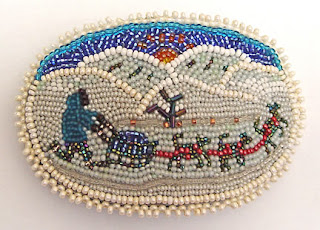
Emphasizing different colors, motifs and techniques, each tribe has its own recognized style. The barrette above and the ones following were made by Northern Alaskan Natives, beaded on hide. They are part of a collection owned by Kathy Hinkle, whose beadwork dolls and improvisational bead embroidery were featured in my previous post here.


An often overlooked, but fantastic place to see and buy Native Alaskan beadwork (and baskets) is at the Alaska Native Medical Center in Anchorage. The current facility, built in the late 1990's, replaces a much older hospital. The gift shop offers very high quality Native arts and crafts. The auxilliary volunteers who ran the shop in the old (and now in the new) facility purchased the best work that came through the shop, establishing a hospital collection, which is displayed in large, beautifully designed cases on each floor of the hospital and in small cases along the grand spiral staircases between the levels. In my opinion, the work in these cases, equals or exceeds any I've seen in a museum; and the work in the gift shop is better than most Anchorage or Sitka galleries or shops offer.
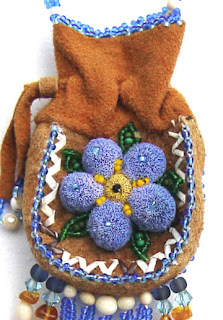
Here is something I bought at this wonderful gift shop.

Made by Thelma Claffey of Huslia AK, this amulet bag of moosehide features caribou tufting, quill work and beads of ivory and amber. It's one of my most prised treasures!

Since I'm on a roll, here are a few sketches from my note book, and a little information about places to see Native American beadwork on the East Coast.

Above is a sketch of the head of a Northern Plains Indian doll from around 1900 seen at the Bruce Museum in Greenwich CT. She has a leather face, bits of leather couched on for ears, a triangle of leather folded and sewn into the shaping seam for her nose. Her cheeks and mouth are painted, but her eyes are glass seed beads.

This is a sketch of another doll I saw and loved, but couldn't afford to buy in the gift shop of the National Museum of the American Indian in New York City. Although she was modern, she had an old-world look and feel. The designs were painted on coarse cloth, and then accented with the traditional colors of opaque and white-heart seed beads. The seams of the doll were embellished with a stitch I'd never seen before and haven't seen since. Made with very tiny seed beads (perhaps size 16), it was dense, like a wrapped seam, but appeared to be woven in a cross-hatch pattern. I spent a whole day in this museum, and wished I had time to return the next day. The exhibitions were supurb.

Here is one other sketch I made while there. It's a Lakota turtle amulet, approximately 7 inches long by 6 inches wide, all done in lazy stitch on hide.
I totally admire artists who keep sketch books, many of which are works of art in themselves. Cynthia Toops is a polymer clay artist, who is always sketching her ideas in little hand-bound books, later to be realized as miniature masterpieces. Inspired by Cynthia, I made a book and vowed to sketch every time something pleased me or caught my eye. That was in April of 1998, and there are still many blank pages in the book. The filled pages infuse my heart with joy and inspiration. What happened? Why haven't I kept it up? This doesn't make sense at all. Do I need to make a blogmittment?
By the way, here is a fun book about art journaling and sketching by Lynne Perrella.